Outsource All the Things
Or not - that was a bit of a clickbait title. Sorry not sorry.


If you thought Mechanical Turk was bad, there’s now a service for AI bots to pay humans to do discrete tasks for them. And yes, the website prominently features the phrase “robots need your body.” It’s continually fascinating to me how many people are willing to, or even enthusiastic about, outsourcing the creative process entirely to an AI Model. This article about authors using AI to write romance novels is, well, interesting:
Ms. Hart has become an A.I. evangelist. Through her author-coaching business, Plot Prose, she’s taught more than 1,600 people how to produce a novel with artificial intelligence, she said. She’s rolling out her proprietary A.I. writing program, which can generate a book based on an outline in less than an hour, and costs between $80 and $250 a month.
But when it comes to her current pen names, Ms. Hart doesn’t disclose her use of A.I., because there’s still a strong stigma around the technology, she said. Coral Hart is one of her early, now retired pseudonyms, and it’s the name she uses to teach A.I.-assisted writing; she requested anonymity because she still uses her real name for some publishing and coaching projects. She fears that revealing her A.I. use would damage her business for that work.
But she predicts attitudes will soon change, and is adding three new pen names that will be openly A.I.-assisted, she said.
The way Ms. Hart sees it, romance writers must either embrace artificial intelligence, or get left behind.
“If I can generate a book in a day, and you need six months to write a book, who’s going to win the race?” she said.
(emphasis mine)
There’s a lot to unpack here, leaving aside the actual quality of prose when we’re comparing human-written bodice-rippers versus robot-generated … circuit-board-fryers(?). I’m not going to really worry about the writing quality of either because, frankly, I would not read either willingly.
I think it’s worth pointing out the line I bolded above. You can generally tell how truly successful something really is by seeing how fast people pivot from doing the thing to selling you a course about doing the thing. If owning franchise businesses selling bulk goods were a surefire way to be rich and not have to work, then why are there so many people selling courses on how to start your own franchise business?
Perhaps a bit of self-reflection is due here, because I’m a lawyer and technically I make a living teaching lawyers how to use AI to help them practice law. But I don’t believe AI makes the really hard parts of practicing law, things such as self-imposed stress and high client expectations, way easier. Rather, my hope is that AI makes the rote and boring parts so stupidly easy we no longer even have to think about them. In other words, I want to keep the human element and automate the scrivening.
I also don’t believe using AI is easy or that getting a Claude Cowork subscription is an easy path to overnight success. This shit is hard. Most lawyers don’t have good systems right now, and “rubbing some AI on it” will, in fact, make bad systems much, much worse. This doesn’t include the intrinsic problems with depending on AI as a replacement for our professional judgment, which people seem very ready to do!
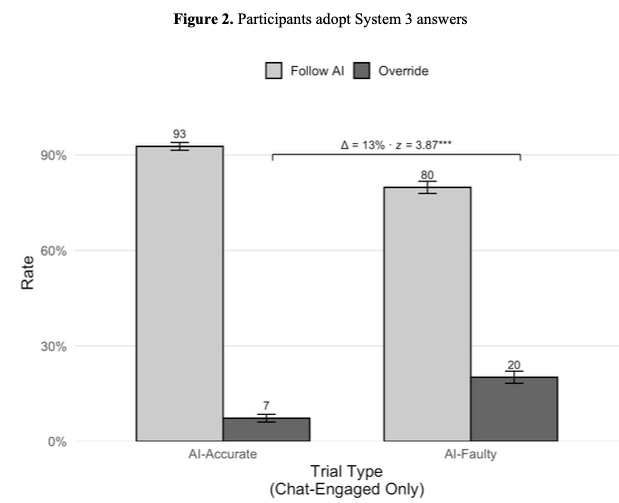
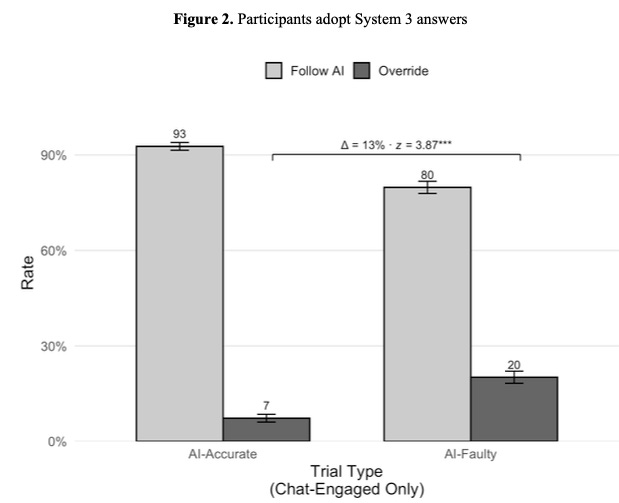
From Thinking - Fast, Slow, and Artificial: How AI is Reshaping Human Reasoning and the Rise of Cognitive Surrender.
If you haven’t yet, go and read David Colarusso’s thread on Bluesky about teaching his law students about automation bias, and play through his Citation Tool Test to see it in action:
But keep in mind that AI systems are improving rapidly (Opus 4.6 is extraordinary) and some studies show they’re better at correctly applying legal principles than human federal court judges:
From Silicon Formalism: Rules, Standards, and Judge AI.
All this to say that we need to make sure we’re being intentional about how things get rolled out at this point. We need to think carefully about what we want to outsource before we get outsourced. Law Town still needs a mayor to work and actually deliver value.